AutoShade — Smart Window Blind Controller
A retrofit smart blind actuator with battery, USB-C, or solar power. Multiple units connect to a central hub via Zigbee/Matter for home automation integration using ESP32-C6.
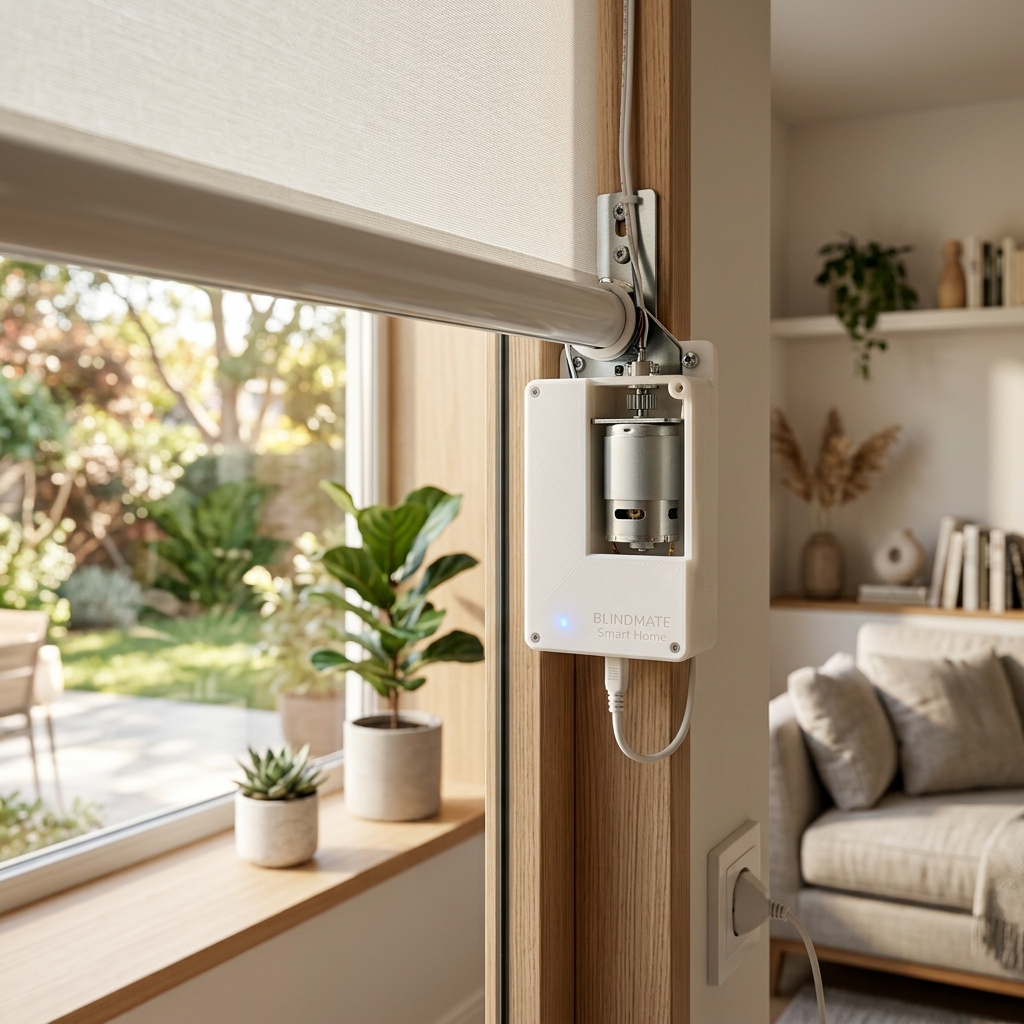
Overview
AutoShade is a compact motorized actuator designed to retrofit onto existing roller blinds and shutter windows, converting them into smart blinds without replacing the entire window treatment. Each unit clamps onto the blind mechanism and provides motorized open/close control.
The system is designed around a hub-and-node architecture: multiple blind actuators communicate wirelessly with a central hub, which bridges to your phone and existing smart home ecosystem via standard home automation protocols.
System Architecture
| Component | Technology | Details |
|---|---|---|
| Actuator MCU | ESP32-C6 | Low-power SoC with native Zigbee/Thread and BLE support |
| Motor | 12V DC gear motor | Quiet operation with torque sufficient for standard roller blinds |
| Motor Driver | DRV8837 | Low-side H-bridge with sleep mode for battery conservation |
| Power Options | Li-Ion battery / USB-C / Solar | Onboard BQ25185 charger IC with MPPT for solar input |
| Hub | ESP32-S3 + Ethernet | Central coordinator running Zigbee2MQTT, bridging to Home Assistant |
| Protocol | Zigbee 3.0 / Matter | Mesh networking for whole-home coverage; Matter for cross-platform compatibility |
| Sensors | ALS + temperature | Ambient light sensor for auto-schedule; temp sensor for climate-aware control |
Execution Plan
- Phase 1 — Prototype actuator node: ESP32-C6 dev board + motor driver breakout on breadboard, validate motor control and Zigbee pairing
- Phase 2 — Custom PCB design in KiCad: integrated MCU, motor driver, battery management (BQ25185), and solar input circuit on a single 2-layer board
- Phase 3 — Mechanical design: 3D-printed enclosure that clips onto standard 38mm roller blind tubes
- Phase 4 — Hub design: ESP32-S3 carrier board with Ethernet (W5500), Zigbee coordinator radio, and USB-C power
- Phase 5 — Firmware: Zigbee end-device stack, OTA updates, light-based scheduling, and Home Assistant integration via MQTT
- Phase 6 — Field test: install 4+ units in a home, validate mesh reliability, battery life, and solar charging efficiency
Key Design Considerations
- Ultra-low standby power — target < 10µA sleep current for months of battery life between charges
- Solar MPPT — efficient energy harvesting from small (1W–2W) window-mounted solar cells
- Retrofit-friendly — no permanent modifications to existing blinds or windows
- Mesh networking — Zigbee mesh ensures coverage even in large homes with thick walls
- Quiet operation — gear motor selection and PWM ramp profiles to minimize noise