Low Power AI-enabled Contextual Awareness
An independent, modular, low-power, always-on contextual awareness system for a concept notebook using multiple sensing modalities — UWB radar, capacitive sensing, charge domain imaging, ALS, and IMU — with on-device ML classification.
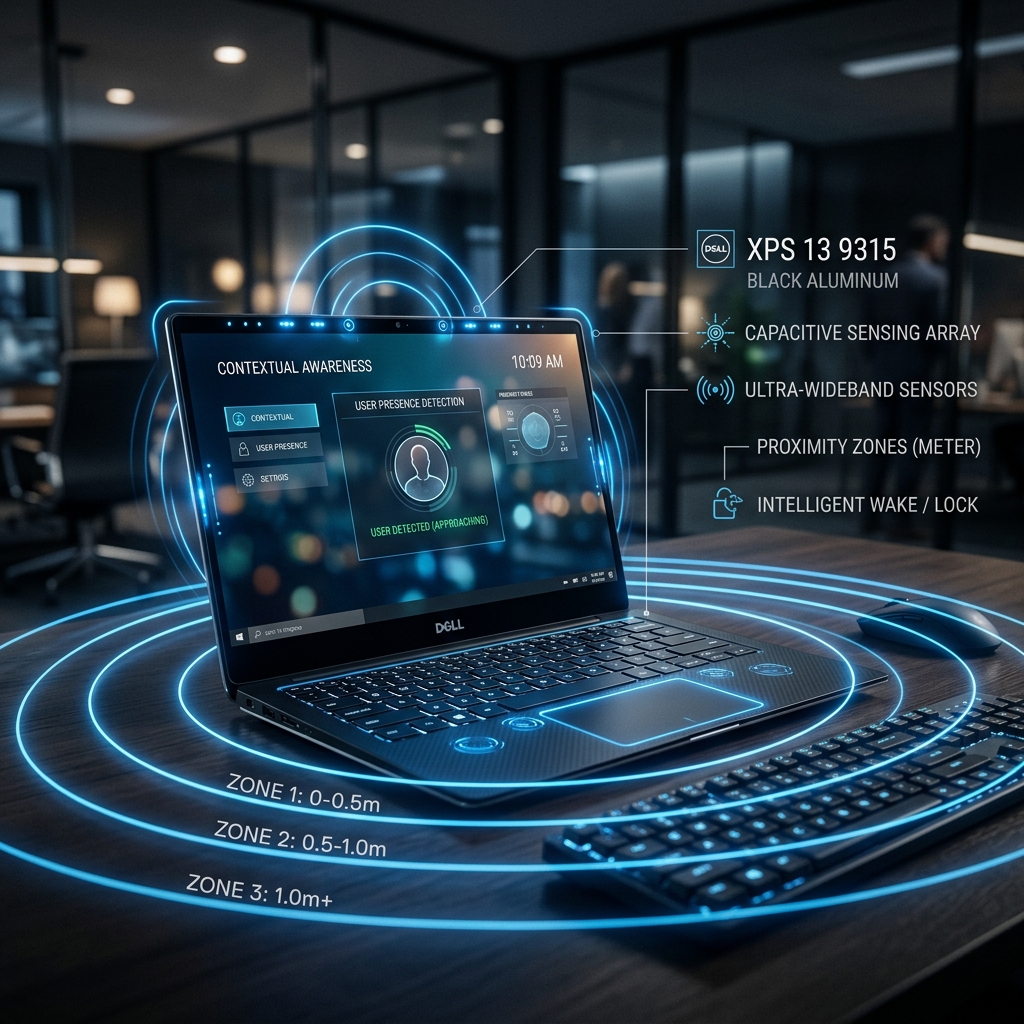
Overview
The goal of this project was to create an independent, modular, low-power, always-on contextual awareness system for a concept notebook built by Dell’s SVT team, using multiple sensing modalities and intelligent processing.
Sensor Fusion
The system integrates multiple sensor types:
- UWB Radar
- Ambient Light Sensor (ALS)
- Charge Domain Image Sensor
- IMU (Inertial Measurement Unit)
- Capacitive Sensing
Capacitive Proximity and Touch Detection
Used a low-power capacitive sensing IC to evaluate using the metal laptop housing as a human touch and proximity sensing node. Developed multiple POC iterations to improve proximity performance, achieving 2–3 ft detection range with a floating housing design.
Led testing efforts to evaluate and mitigate the negative effects of a floating housing on RF desense, EMI, and ESD.
Charge Domain Sensor
Investigated the unique properties of charge domain image sensing and challenges in integrating it within a laptop form factor.
UWB Radar Sensor
Evaluated UWB radar integration at the base of the laptop, addressing RX/TX antenna dimensions, spacing requirements, and signal propagation challenges.
Note: Due to confidentiality, actual images from work cannot be shared. The image shown is a close approximation of the system we validated.